Why was anointing with olive oil the foundational ritual of every athlete in the gymnasia of ancient Greece? Far from an archaic quirk or a primitive substitute for soap, olive oil was an unparalleled biological, thermal, and biomechanical shield—the earliest natural “tan” in history, catching light on muscular contours while shielding deep tissues. While modern bodybuilding strips and dehydrates the epidermis as a mere temporary stage screen, the Ancients revered the skin as the body’s primary organ of strength and longevity—elevating the mixture scraped by the strigil, the famed gloios, into one of the ancient world’s most prized medicines.
Key Takeaways:
- A Biological Armor: Olive oil anointing (elaion) shielded Greek athletes from searing sun, dry coastal winds, and abrasions during combat.
- The Art of the Strigil: This curved bronze blade cleared dirt without harsh soaps while activating microcirculation and lymphatic drainage.
- The Treasure of Gloios: The scraped mixture of sweat, oil, and dust was auctioned to fund gymnasia and prescribed by Galen and Pliny the Elder as a potent anti-inflammatory balm.
- Removing and Healing Competition Tan: Replacing harsh abrasives with warm olive oil dissolves contest tan through lipid affinity while restoring the intercellular lipid matrix and fascial gliding.
1. Anointing in the Palaestra: Why Olive Oil Shielded Ancient Greek Athletes
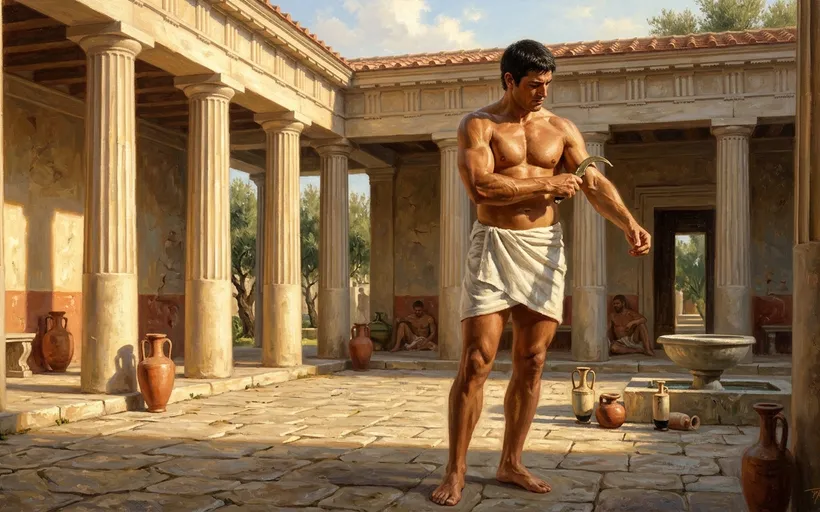
The midday sun beats down upon the stone peristyle. You have just stepped through the gates of the ancient Greek gymnasium. Around you, glistening bodies warm up in brilliant Mediterranean light.
Before stepping onto the sand of the palaestra, you must disrobe completely. Such is the law of Olympia: gymnos, naked, exposed to the elements.
Yet your skin does not remain defenseless. The oil arrives.
The Thermal and Mechanical Shield Against the Mediterranean Sun
A trainer pours a generous measure of virgin olive oil (elaion) across your shoulders. The initial sensation is striking: a dense coolness gliding over your trapezius, followed by a gentle warmth as it is vigorously rubbed in.
This anointing serves no frivolous vanity. It constitutes a vital physiological barrier.
Under the dry Aegean wind and intense ultraviolet rays, bare skin parches in minutes. Transepidermal water loss surges.
Rich in monounsaturated fatty acids and natural squalene, olive oil seals moisture deep within the stratum corneum, creating a protective lipid mantle.
Mechanically, this oily film drastically reduces friction burns during intense grappling. Opponents slide off your forearms, and gravel abrasions are substantially cushioned.
The Veil of Mineral Dust (Konis) and Thermal Regulation
Once the oil is spread, the protocol continues. The trainer reaches into an earthenware jar and draws out a fine powder: mineral earth dust (konis).
With a sweeping gesture, he dusts this silt across your torso. The earth adheres instantly to the oily film.
This fusion creates a unique texture—coarse yet gripping. The dust neutralizes excessive slip to allow wrestling holds, while serving as a remarkable thermal regulator.
By absorbing the first beads of sweat without dissolving the underlying oil layer, it prevents rapid electrolyte depletion. You now possess a second skin, tempered to withstand physical combat.
2. The Aleiptes and the Strigil: Soap-Free Hygiene for Microcirculation
Training ends amidst heavy breathing. Your muscles throb with blood and metabolic fatigue. You leave the combat pit to enter the shaded exedra of the baths.
You are coated in a thick crust: salt sweat, oxidized oil, and red earth. Yet no soapy water is brought.
Potash soap did not exist in classical Greece. The Ancients practiced a method of cutaneous purification far more respectful of living tissue.
The Aleiptes: Early Athletic Trainer and Field Physician
The aleiptes approaches. In the ancient gymnasium, this man was no mere bathhouse attendant.
He studied empirical anatomy, muscle tension trigger points, and Hippocratic humors. He evaluates the contour of your deltoids, assesses lumbar stiffness, and checks the texture of your sweat.
His hands execute deep sliding strokes along muscular pathways. This post-workout massage drains fluid stagnation, calms neuromuscular spasms, and begins loosening the crust lodged in your pores.
The Sweep of the Strigil: Lymphatic Drainage and Fascial Regeneration
Then comes mechanical relief. The aleiptes takes up the strigil, a refined instrument of polished bronze with a curved, concave blade.
He rests the curved edge against your skin with calibrated pressure. The motion is ascending, following venous and lymphatic return from ankles toward thighs, from wrists toward sternum.
The cool metal scrapes the skin. The contact is neither painful nor cutting; it offers deep muscular relief, analogous to modern instrument-assisted soft tissue mobilization (IASTM).
With fluid strokes, the strigil sweeps away dirty oil, dead cells, and toxins without disrupting the underlying lipid film. Under the blade, your skin re-emerges rosy, supple, and invigorated by restorative blood flow.
3. The Mystery of Gloios: From Wrestlers’ Sweat to Galen and Pliny’s Treatises
Look at what collects in the groove of the strigil: a dark, viscous mixture dripping into a bronze basin. The Greeks called it gloios (known as strigimentum in Rome).
To a modern observer, this sludge might appear as repulsive waste. In Antiquity, it was exactly the opposite: a valuable medicinal substance, commanding high prices from apothecaries and healers.
The Stele of Beroea: How Gymnasium Residue Funded Ancient Cities
Historical proof survives engraved in stone. Discovered in Macedonia, the Gymnasiarchical Law of Beroea (2nd century BC) regulated the administration of sports facilities.
One decree specifically ruled that the gloios scraped from athletes’ bodies and gymnasium floors was the legal property of the gymnasium. The presiding magistrate auctioned this residue publicly each year.
The revenue generated was substantial, directly subsidizing fresh olive oil shipments for subsequent training seasons. Athletes’ sweat literally funded the training of future generations.
The Ancient Pharmacopoeia: Anti-Inflammatory and Joint-Healing Balm
Who bought this mixture, and why? The most renowned physicians of Antiquity were eager customers.
In his encyclopedic Natural History (Book XXVIII), Pliny the Elder documents the healing virtues of strigimentum. While noting its crude origin, Pliny recognizes its clinical power to calm joint inflammation, disperse hard swellings, and relieve tendon contractures.
The Greek-born physician Claudius Galen incorporated it into his pharmaceutical treatises (De compositione medicamentorum), prescribing gloios-based salves for sciatica, synovial effusions, and rheumatic pain.
Pharmacologist Dioscorides likewise praised its emollient properties on deep contusions.
Modern biochemistry validates this ancient intuition. Gloios concentrated olive oil polyphenols, human sebum squalene, and organic salts excreted during exertion. Applied as a warm poultice, it acted as a transdermal balm accelerating hematoma reabsorption and easing fascial stiffness.
4. From Gloios to Competition Tan: The Dermatological Aberration of Modern Bodybuilding
Now take a stark leap across time. Leave the palaestra of Olympia and step into the backstage washroom of a 2026 bodybuilding auditorium.
The aroma is no longer blooming olive groves, but isopropyl alcohol, chemical strippers, and synthetic fragrances. An athlete scrubs his skin raw with an abrasive mitt and glycolic-salicylic acid peel.
The contrast is striking. Where the Ancients nourished the skin into a biological fortress, contemporary contest bodybuilding treats it as an inert canvas to be sanded down for artificial pigments.
Contest Tanning, Solvents, and Chemical Peels: The Stage Skin Ordeal
To prepare for dihydroxyacetone (DHA) spray tanning, standard protocols demand ruthless stripping. For forty-eight hours before stepping on stage, competitors must wash away every trace of natural sebum using harsh astringents and scalding showers.
Coupled with severe caloric restriction and last-minute dehydration protocols, this treatment leaves the epidermis depleted, wrinkled, and unable to maintain moisture barrier function.
Modern Science: The Impact of Transepidermal Water Loss (TEWL) on Muscle
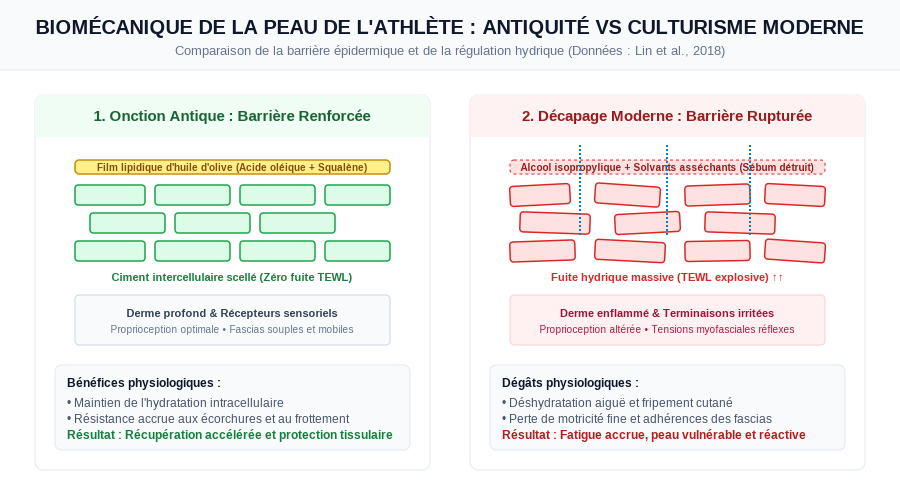
Dermatological research underscores the dangers of lipid barrier depletion. In their review on plant oil therapeutic properties, Lin, Zhong, and Santiago demonstrate that stratum corneum integrity is fundamental to systemic homeostasis.
When surface lipids are washed away by solvents, Transepidermal Water Loss (TEWL) escalates sharply. The skin becomes porous, inflamed, and hyper-reactive.
For strength athletes, compromised skin disrupts sensory nerve endings. Proprioception dulls: Pacinian and Ruffini corpuscles in the deep dermis fire distress signals that trigger involuntary guarding tone, hindering neuromuscular control during maximum poses. By damaging his skin to appear dry under stage lights, the modern athlete undermines the very interface of muscular power.
5. Replacing Solvents with Anointing: How to Dissolve Fake Tan and Rebuild the Skin
This is not a call to reject modern athletic disciplines, but an invitation to leave biological amnesia behind. The moment contest curtains fall, the athlete must cease treating skin as a disposable consumable.
Restoring the cutaneous barrier directly governs systemic recovery speed and heavy lifting longevity.
Post-Contest Protocol: Removing Competition Tan with Olive Oil Without Ruining the Skin Barrier
After days of chemical saturation, violent scrubbing only worsens tissue damage. A gentle transition is essential:
| Care Step | Common Modern Mistake | Antiquity-Inspired Protocol | Direct Recovery Impact |
|---|---|---|---|
| Tan Removal | Aggressive scrubbing with loofahs and stripping soap | Emulsion dissolution with warm plant oil (olive or jojoba) | Color removal without tearing the stratum corneum |
| Lipid Restoration | Water-and-alcohol body lotions | Pure extra-virgin olive oil massaged into damp skin | Rapid intercellular cement rebuilding; halts TEWL |
| Fascial Work | Ignoring cutaneous health during off-season | Slow, deep manual friction along muscular lines | Edema drainage and myofascial glide restoration |
Why the Strength Athlete Must Nourish the Living Sheath
In your pursuit of hypertrophy and raw power, heavy squats, deadlifts, and presses stretch your skin to its elastic limits. When the dermis is dry, lipid-depleted, and inflamed, underlying fascial layers lose mutual glide. Micro-adhesions develop between skin and superficial fascia.
By reintroducing weekly anointing with cold-pressed virgin plant oils, you nourish keratinocytes with vitamin E and antioxidant polyphenols. You restore mechanical suppleness, improve knurling friction tolerance, and accelerate soft tissue recovery.
6. The Sacred Envelope: Reconciling Raw Power and Bodily Nobility
Rerack the barbell. The training session draws to a close. Quiet returns to the gym floor.
Look at your calloused hands, your shoulders, the network of veins pulsing beneath your skin.
You understand now that an athlete’s power does not reside solely in the thickness of contractile muscle fibers. It lives in the unbroken harmony between muscle and the living membrane that houses and protects it.
The Greeks of the classical age were no naive romantics. They were seasoned wrestlers, soldiers, and acute observers of human physiology. By sanctifying olive oil, making the strigil a tool of fascial recovery, and transforming gloios into a restorative balm, they reminded us of an enduring truth: authentic power always honors its envelope.
To continue exploring the origins of physical culture and the timeless secrets of human strength, explore our era dedicated to The Ancient Origins of Force and read about our editorial approach.
7. Frequently Asked Questions (FAQ)
Why did ancient Greeks apply olive oil before exercise rather than after?
Anointing with olive oil before training functioned as a preventive shield. It protected the skin against drying sea winds and harsh Mediterranean UV rays, while creating a mechanical barrier that minimized friction and abrasions during wrestling bouts. After training, an additional oil massage was administered by the aleiptes to relieve muscular tension.
What was gloios and why did it hold official commercial value?
Gloios (known as strigimentum in Rome) was the viscous mixture scraped from athletes’ skin after exercise, consisting of olive oil, sweat, palaestra dust, and exfoliated skin cells. Rich in polyphenols and electrolytes, it was highly sought after by physicians such as Galen and Pliny the Elder to create anti-inflammatory balms, to the point where its public auction funded ancient gymnasia.
Was the bronze strigil painful or abrasive to the skin?
No. The strigil featured a curved, blunted blade precisely contoured to follow anatomical shapes without cutting. Gliding smoothly over heavily oiled skin, it performed deep lymphatic drainage combined with gentle mechanical exfoliation without chemical detergents.
How can strength athletes repair their skin after using competition spray tan?
To restore the lipid barrier stripped by harsh contest prep, athletes should avoid aggressive soaps and instead use warm plant oils (such as olive or jojoba) to gently emulsify and dissolve fake tan. Daily application of pure extra-virgin olive oil on damp skin quickly rebuilds the intercellular lipid cement.
How to remove bodybuilding competition tan without damaging the skin?
Rather than using harsh solvent strippers or abrasive scrubbing mitts that tear off viable stratum corneum, apply warm extra-virgin olive oil generously to dry skin. Through lipid affinity, the oil dissolves the synthetic binders and bronzers while softening pigmented cells without barrier disruption. Rinsing with warm water and a mild superfatted soap or soft cloth completes gentle removal inspired by ancient palaestra hygiene.