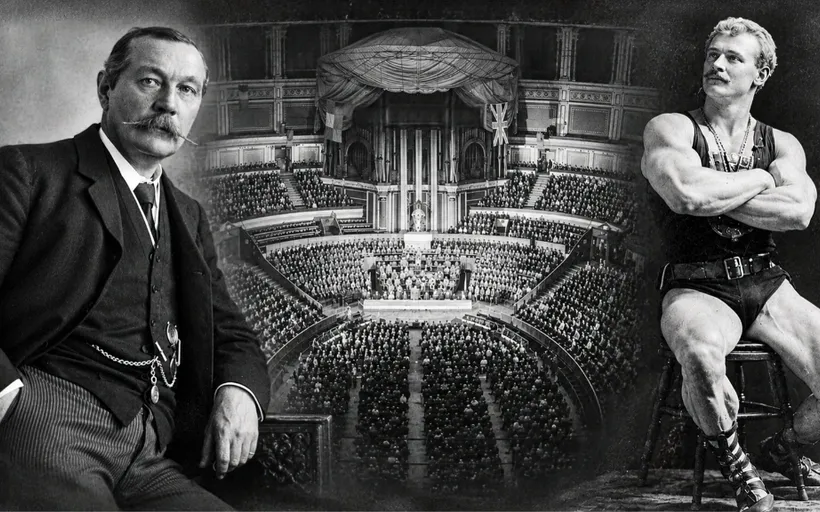
On September 14, 1901, beneath the vaulted glass dome of London’s Royal Albert Hall, fifteen thousand spectators held their collective breath. Before them unfolded the finale of The Great Competition, a pivotal milestone documented in the annals of modern physical culture and universally recognized as the first bodybuilding contest of 1901. Yet seated at the judges’ dais, you would search in vain for a gym owner or a veteran iron-heaver. To evaluate the finalists, Eugen Sandow had assembled an extraordinary panel: Sir Arthur Conan Doyle, the creator of Sherlock Holmes, and Sir Charles Lawes-Wittewronge, royal academician sculptor and champion oarsman.
Why this unorthodox choice? In 1901, bodybuilding had not yet emerged as an autonomous athletic discipline. To emancipate physical culture from carnival fairgrounds and establish its dignity before Victorian high society, Sandow enlisted two unimpeachable arbiters: medical science and classical sculpture.
In Brief:
- The Founding Milestone: On September 14, 1901, Eugen Sandow organized London’s inaugural international physical culture contest.
- A Jury Without Strongmen: Lacking established competitive precedents, Sandow entrusted the adjudication to two eminent outsiders: novelist-physician Arthur Conan Doyle and royal sculptor Sir Charles Lawes.
- The Quest for Nobility: This strategic appointment dissociated muscle from vulgar music-hall exhibitions, placing it beneath the patronage of medicine and fine arts.
- Sandow as Referee: Sandow recused himself from primary voting, retaining only the casting vote in the event of deadlock to guarantee absolute impartiality.
1. The Illusion of the Void: Why 1901 Had No Bodybuilder Judges
When examining vintage competitions through the lens of modern federations, we risk committing an uncritical anachronism. We inadvertently project onto the dawn of the twentieth century administrative and competitive structures that possessed neither legal sanction nor technical recognition at the time.
The World Before: Strongmen Relegated to Carnival Booths
In late Victorian Britain, public feats of physical strength carried little academic or social prestige. Strength performers belonged almost exclusively to tavern backrooms, traveling circuses, and fairgrounds. Crowds gathered to marvel at tavern hercules bending iron bars over their chests or lifting horses upon wooden platforms.
These figures suffered an unsavory reputation. Polite Victorian society viewed them with suspicion, associating their coarse, thick physiques and abdominal adiposity with heavy drinking and rowdy spectacle. Nothing in their bulky silhouettes recalled the graceful harmony of Greco-Roman sculpture.
Eugen Sandow, having himself risen from the music-hall stage where he dethroned rival strongmen Sampson and Cyclops, recognized this cultural impasse. He understood that so long as muscular development remained confined to sideshow boards, it could never transcend the status of fleeting, lowbrow entertainment.
The Imperative of Victorian Legitimacy
To elevate an exhibition of physical prowess into an enduring athletic movement, Sandow had to capture the respect of London’s intellectual, medical, and aristocratic elite. He had to demonstrate that deliberate bodily culture constituted a patriotic, hygienic, and aesthetic virtue of the highest order.
Placing fellow strongmen on the jury would have doomed this ambition from the outset. Professional lifters of the era were embroiled in constant promotional feuds, staged challenges, and mutual accusations of deception. Appointing them would have trapped the evening in the carnival folklore Sandow sought to escape, deterring the serious press from covering the event.
Sandow’s strategic stroke was masterful: appoint arbiters whose social standing, intellectual renown, and moral integrity stood entirely above suspicion.
2. Dr. Arthur Conan Doyle: The Lens of Medical Science and Moral Rectitude
The presence of the literary mind behind the world’s most famous analytical detective was no superficial publicity stunt. The gentleman who took his seat opposite the competitors possessed a dual identity unfamiliar to many modern readers: he was both a qualified medical doctor and a dedicated practitioner of physical culture.
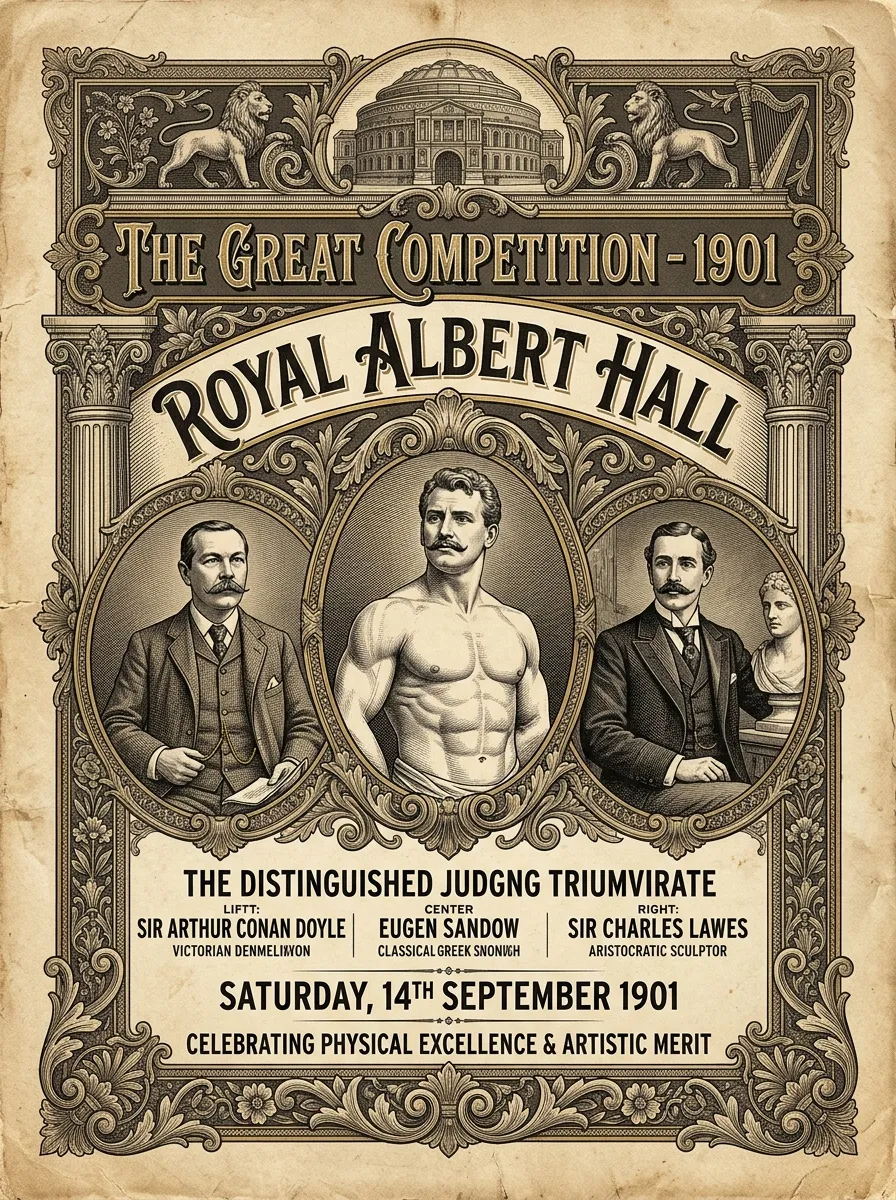
Official Victorian poster of The Great Competition (1901) — Left to right: Sir Arthur Conan Doyle, Eugen Sandow, and Sir Charles Lawes.
| Role at the 1901 Contest | Personality | Professional Profile | Decisive Contribution to the Panel |
|---|---|---|---|
| Presiding Medical Judge | Dr. Arthur Conan Doyle | Edinburgh medical graduate, novelist, amateur boxer | Scientific authority, hygienic credibility, moral probity |
| Presiding Aesthetic Judge | Sir Charles Lawes | Royal academician sculptor, Henley Diamond Sculls champion | Anatomical precision, Polykleitan canon, artistic eye |
| Referee & Arbiter | Eugen Sandow | Founder of the training system, world-renowned athlete | Impartial oversight, casting vote in case of deadlock |
Sandow’s Secret Pupil: Athletic Brotherhood and Mutual Regard
In his autobiographical volume, Memories and Adventures (1924), Conan Doyle candidly recounted the origin of their association:
“I had taken a course of muscular development with Mr. Sandow, the strong man, and that was how I made his acquaintance. In the winter of 1901 Mr. Sandow showed a worthy desire to do something for the wounded British soldiers from the Boer War, and with this idea he announced a competition at the Royal Albert Hall… Sandow asked Lawes the sculptor and myself to be the two judges, he himself acting as referee.”
Sir Arthur Conan Doyle was far from a sedentary man of letters. An ardent amateur boxer in London rings, a regular cricketer for the Marylebone Cricket Club, and an amateur association football goalkeeper in Portsmouth, Doyle revered disciplined athleticism. Having tested Sandow’s spring-grip dumbbells and isometric exercises on his own frame, he had directly verified their effects upon muscle tone and daily stamina.
The Edinburgh Hallmark: Muscle as the Bastion of Hygiene
Trained at the prestigious University of Edinburgh Medical School under the legendary Dr. Joseph Bell—whose extraordinary observational diagnostics served as the blueprint for Sherlock Holmes—Doyle brought irreplaceable scientific gravitas to the competition.
At a time when orthodox Victorian physicians warned of cardiac strain and premature exhaustion from heavy lifting, Dr. Doyle championed progressive hygiene. To his mind, measured muscular hypertrophy was neither an unnatural distortion nor a dangerous excess, but the vital biological bulwark against the sedentary enfeeblement brought on by industrial urbanization.
From his seat at the judging table, Doyle looked through the clinical eye of a diagnostic physician: assessing tissue density, thoracic expansion, abdominal firmness, and spinal rectitude.
3. Sir Charles Lawes: Guardian of the Classical Canon and Greek Ideal
While medical science assured physiological health, who would evaluate sculptural beauty? Here entered the second pillar of the jury, frequently overshadowed by his literary colleague: Sir Charles Bennet Lawes-Wittewronge.
The Royal Sculptor Who Appraised Living Flesh Like Marble
A baronet educated in the sculpture ateliers of London and Berlin, Sir Charles Lawes was an acknowledged authority in British fine art. Later elected president of the Royal Society of British Sculptors, Lawes spent his lifetime carving stone and casting bronze into heroic figures, epitomized by his colossal bronze group The Death of Dirce.
Lawes appraised the contestants not as collections of hypertrophied muscle bellies, but as living statues governed by the classical canon of Polykleitos. In the vision shared by Sandow and Lawes, the purpose of physical culture was not to crown the largest bicep, but to reconstruct the balanced architecture of the ancient Doryphoros.
Every line was weighed against another:
- Neck circumference was expected to mirror the contracted arm and calf measurements.
- Clavicular width had to taper harmoniously into a lean waistline.
- Muscular contours were never permitted to disrupt the kinetic elegance of the whole silhouette.
An Oarsman Among Aesthetes: Lawes’ Elite Athletic Pedigree
Charles Lawes was no armchair anatomist. During his university years at Cambridge, he had stood among Britain’s premier amateur athletes. In 1863, he won the prestigious Diamond Challenge Sculls at the Henley Royal Regatta, before clinching the amateur one-mile championship of England in track athletics.
Well past the age of fifty-five, Lawes continued to set amateur track cycling speed records. He knew firsthand the sweat and repetitive toil required to forge athletic tissue. This rare synthesis of a sculptor’s spatial eye and a competitor’s visceral experience made him the finest aesthetic judge in the British Empire.
4. Inside the Deliberations: When the Judges Refused to Settle
The actual conduct of the evening demonstrated the rigor with which this unique tribunal discharged its duties before the packed Royal Albert Hall.
Sandow as Impartial Referee: A Strategic Masterstroke
Eugen Sandow’s organizational prudence warrants special note. Although he had organized the event, devised the training systems, and coached many of the entrants, he explicitly declined to cast primary ballots.
Assuming the neutral mantle of referee, Sandow reserved the right to intervene solely if Doyle and Lawes reached an irreconcilable tie. This strict separation of judicial powers endowed the final verdict with an unassailable aura of legitimacy.
Conan Doyle’s Intimate Account: Sorting Eighty Champions for William Murray
In Memories and Adventures, Conan Doyle recalled the formidable visual and intellectual task set before them:
“The hall was packed. There were eighty competitors, each of whom had to stand upon a pedestal… Lawes and I had them up ten at a time, picking one here and one there, and gradually boiling them down until only six were left. Then the task became one of extreme difficulty, for they were all beautifully developed men.”
Doyle and Lawes confronted a classic connoisseur’s dilemma. While every finalist displayed remarkable muscularity, the two judges probed for the subtlest postural and structural flaws:
- One leading contender was admired for his great development, yet was deemed “a little too heavy, a little clumsy” in his gait.
- Another possessed astonishing definition, yet lacked sufficient skeletal breadth, appearing “a little too short.”
Ultimately, a modest athlete from Nottinghamshire, William L. Murray, earned the unanimous consensus of both arbiters. While not possessing the largest arm on stage, Murray’s bone structure, flowing lines, erect carriage, and classical balance epitomized the living sculpture Doyle and Lawes demanded.
| Selection Stage (1901) | Competitors Evaluated | Judging Method | Elimination Criterion |
|---|---|---|---|
| Preliminary Round | 80 regional winners on pedestals | Visual evaluation in groups of 10 | Postural asymmetry, disproportionate bulk |
| Final Six | 6 finalists selected | Exhaustive clinical scrutiny & caliper comparison | Heaviness of stride, skeletal compression |
| Final Verdict | William Murray crowned | Unanimous accord of Doyle and Lawes | Flawless proportions, noble carriage, balanced physique |
The Midnight London Anecdote: Doyle and the Wandering Champion
The aftermath of the contest produced a scene worthy of a Victorian short story. Following an opulent champagne banquet that stretched into the early hours, Conan Doyle departed around three o’clock in the morning.
In the freezing London mist, the author spotted a solitary figure walking the deserted pavement: it was William Murray, the newly crowned champion of England, tightly clutching under his coat the heavy solid-gold statuette awarded to him earlier that evening.
Doyle approached and questioned him. The candid provincial admitted that he had not a penny left to pay for a London hotel room: holding only a return train ticket north scheduled for dawn, he planned to wander the cold streets until departure.
Refusing to leave this broke champion and his precious gold trophy vulnerable to midnight street robbers, Doyle whisked him immediately to his own residence at the Morley’s Hotel. He booked a room for Murray and instructed the astonished night porter:
“Take great care of this man, for he has just been proclaimed the most beautifully built man in England.”
The following morning, Murray held court in his room as chambermaids and waitstaff filed in to marvel at the champion and his golden prize. When Murray confided that he considered pawning the statue to survive, Conan Doyle gave him shrewd counsel: return to the North, open a physical culture academy, and place the trophy in the front window as his calling card. Murray followed the author’s advice to the letter, building a flourishing career upon it.
5. The Living Legacy of 1901: What the Founding Jury Bequeathed to Modern Bodybuilding
The 1901 contest was no fleeting Victorian curio. By installing a physician and a sculptor at the helm of physical culture, Eugen Sandow established enduring principles that continue to reverberate across the iron game today.
The Birth of the Immortal Trophy
The supreme award bestowed upon William Murray that evening was a golden statuette standing some twenty inches tall, sculpted from life by the celebrated artist Frederick Pomeroy in 1891. It depicted Eugen Sandow standing proudly beside a globe-ended barbell.
This iconic artwork survived the century. Revived in 1977 by Ben and Joe Weider, a bronze casting of this original Victorian statue became the ultimate prize awarded to the world’s greatest physique champion: the Mr. Olympia.
When Frank Zane, Lee Haney, Dorian Yates, Ronnie Coleman, or contemporary champions lift the Sandow trophy overhead in Las Vegas or Orlando, they hoist the exact artistic work validated by Arthur Conan Doyle and Sir Charles Lawes in London over a century ago.
The Lesson of 1901 for Contemporary Athletes
In modern gyms, the temptation to chase sheer poundages and unguided mass disconnected from function remains widespread. As an athletic coach and physical culture chronicler, I witness daily how contemporary hypertrophic pursuits can lose touch with their structural foundations.
The enduring philosophy of the 1901 jury rests upon three immutable tenets:
- Structural Integrity Precedes Load: The joint health and spinal alignment scrutinized by Dr. Doyle must always govern training progression. Compromised tissue cannot sustain true strength.
- The Primacy of Proportion: Sir Charles Lawes’ aesthetic eye reminds us that muscular development derives its nobility from balance. Accumulating ungainly bulk at the cost of mobility and posture represents no athletic triumph.
- Moral Self-Mastery: Physical culture is not an exercise in vanity. It remains a lifelong discipline of self-refinement, uniting the empirical rigor of the clinical laboratory with the aesthetic nobility of classical sculpture.
To explore this lineage and trace the evolution of the aesthetic ideal across the decades, delve into our archives dedicated to the Pioneers of Physical Culture.
6. Frequently Asked Questions about the 1901 Jury
Why were there no bodybuilders on the 1901 judging panel?
Bodybuilding did not yet exist as an autonomous, codified sport with certified officials. Contemporary strongmen were rival circus performers. To eliminate bias and confer instant respectability before the Victorian public, Eugen Sandow deliberately selected eminent external authorities from academic medicine and the fine arts.
How did Arthur Conan Doyle meet Eugen Sandow?
Conan Doyle was an ardent athlete, amateur boxer, and cricketer. He met Eugen Sandow by personally enrolling as a pupil in one of Sandow’s physical culture training courses in London. Deeply impressed by the improvements in his own vigor, he developed a lasting friendship with the Prussian athlete.
What exact criteria were used to select the winner?
Unlike traditional strongman feats, competitors were not judged on raw weight hoisted or isolated arm circumference. Criteria centered on symmetrical bodily proportions derived from ancient Greek statuary, muscular definition, posture, and visible tissue vitality.
What was Eugen Sandow’s exact role in the deliberations?
Eugen Sandow voluntarily refrained from scoring the contestants to avoid any conflict of interest as the organizer. He served as the referee, retaining the authority to step in only if Arthur Conan Doyle and Sir Charles Lawes could not reach a unanimous agreement.
What is the direct link between this 1901 contest and Mr. Olympia?
The 1901 champion, William Murray, was presented with a gilded statuette of Eugen Sandow sculpted by artist Frederick Pomeroy. In 1977, this exact statuette was resurrected by the IFBB to become the supreme official trophy awarded annually to the winner of the Mr. Olympia contest.