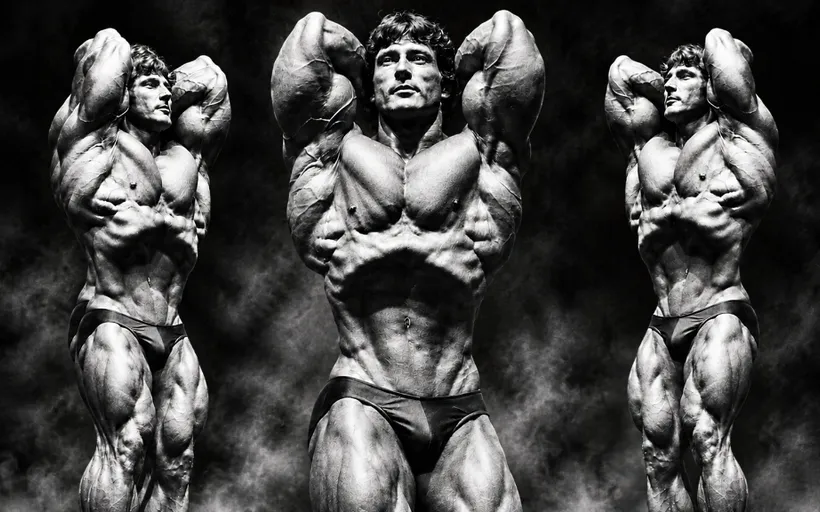
The Frank Zane stomach vacuum is a hypopressive respiratory and postural maneuver targeting the deep transversus abdominis muscle. Inherited from traditional yoga, this technique creates an intense subcostal vacuum following a complete pulmonary exhale, drawing the internal viscera firmly against the spinal column. Through this supreme neuromuscular mastery, Zane chiseled his legendary 29-inch (73 cm) waistline and captured three consecutive Mr. Olympia titles (1977–1979) against towering rivals weighing thirty to fifty pounds more.
The exercise does not burn localized body fat. Rather, it tightens the anatomical core corset, reinforces lumbar stability, and provides an enduring defense against abdominal distension.
Key Takeaways: The 4 Pillars of Frank Zane’s Stomach Vacuum
- A 29-inch waist at 185 pounds: Frank Zane dominated world bodybuilding by establishing classical Golden Era shoulder-to-waist proportions over raw bulk.
- The primacy of the transversus: Unlike the superficial rectus abdominis taxed by crunches, the transversus acts as an internal horizontal belt that pulls the abdominal contents inward.
- The false ribcage inspiration: True vacuum mechanics transcend voluntary belly sucking; they rely on full-exhale apnea and costal expansion that suctions the diaphragm upward.
- A progressive empty-stomach protocol: Performed each morning across four postural stages (from quadruped to upright arms-overhead), combined with the cross-bench dumbbell pullover to expand the ribcage.
1. Frank Zane’s Legacy: When Symmetry Defeated the Giants at Mr. Olympia
1.1 Venice Beach 1977: The triumph of proportion over sheer mass
Under the blazing lights of Columbus in 1977, the final scorecard seemed to defy physical intuition. Facing granite-dense behemoths weighing well over 220 pounds like Robby Robinson, one man stepped forward at a poised 185 pounds (84 kg) standing 5 feet 9 inches tall. His name was Frank Zane.
That evening, the scale ceased to govern physical culture. According to the official archives of Frank Zane, the athlete claimed the first of his three consecutive Mr. Olympia crowns (1977, 1978, 1979). His waist, taped at a razor-sharp 29 inches (73.6 cm), created an unprecedented aesthetic shockwave.
Raw mass overwhelmed the senses; Zane’s line captured the soul.
The secret resided in an absolute V-Taper pushed to its architectural apex. Flared lats swept outward like wings above a waistline so narrow it evoked classical Hellenic sculpture. This was no genetic accident. It was the product of unyielding discipline applied to the most neglected muscle in the weight room.
1.2 “The Chemist” and the Yogic Inheritance: From Uddiyana Bandha to the World Stage
In Venice Beach circles, Zane was nicknamed The Chemist. The moniker carried no pharmacological connotation; it honored his university degrees in science and mathematics, matched with an analytical approach to physique development.
Zane observed human anatomy through a logician’s lens. While his peers ground through endless sets of sit-ups to burn waist fat, Zane pursued superior neuromuscular command. He immersed himself in classical Eastern traditions and ancient yogic breathwork.
His technical revelation derived directly from the classical Hatha Yoga Pradipika, penned in the 15th century by Swami Swatmarama. The text outlines Uddiyana Bandha—an upward abdominal lock where the belly retracts inward and ascends beneath the ribs following full exhalation.
Zane adapted this ancestral lock to the bodybuilding stage. In the official photo archives of Frank Zane, one can witness how this subcostal vacuum transformed his final posing presentations.
At the 1979 Olympia, confronting the high-intensity Heavy Duty philosophy spearheaded by Mike Mentzer, Zane refused to match his rival in arm circumference. Instead, he raised his arms, flared his ribcage, and drew his stomach into his spine. Beneath his sternum opened a dramatic chasm of shadow: a masterclass in neuromuscular control that defined the Golden Era of bodybuilding.
2. Functional Anatomy: The Overlooked Biomechanics of the Transversus Abdominis
2.1 The natural core corset: Beyond the “six-pack”
Most fitness enthusiasts focus their abdominal training on the rectus abdominis. These segmented, superficial bands produce the familiar six-pack appearance. Yet their primary mechanical function remains modest: flexing the lumbar spine by drawing the sternum toward the pelvis.
Midsection circumference is governed by an entirely different structure. Deep beneath the internal and external obliques lies the transversus abdominis (transversus abdominis).
As anatomical documentation on the transversus abdominis muscle structure illustrates, it forms the deepest layer of the anterolateral wall. Its fibers do not run vertically; they wrap horizontally, anchoring to the lower six costal cartilages, the iliac crest, and the thoracolumbar fascia posteriorly.
This horizontal orientation makes it a true living girdle. When contracted, it compresses the abdominal viscera, reinforces internal pressure, and reduces resting umbilical circumference. It functions identically to a biological corset.
2.2 Feedforward activation and lumbo-pelvic stabilization: Hodges & Richardson
Beyond aesthetics, the transversus governs spinal safety. Modern clinical research required decades to quantify what Golden Era pioneers experienced empirically during posing practice.
In 1996, a research team led by Paul Hodges and Carolyn Richardson marked a historic breakthrough. Their biomechanical assessment of the transversus abdominis, published in Spine, proved that in healthy individuals, the transversus fires prior to any movement of the extremities.
This contraction is anticipatory (feedforward). Regardless of whether you raise a weight forward, sideways, or overhead, the transversus braces the lumbo-sacral junction milliseconds before limb recruitment occurs.
Four years later, investigations by Hodges and Gandevia published in their study on intra-abdominal pressure and the diaphragm detailed the internal hydraulics of the trunk. The transversus never acts in isolation; it forms a sealed pneumatic chamber with the diaphragm above, the pelvic floor below, and the multifidi posteriorly. This directly echoes Dr. Stuart McGill’s findings: true spinal resilience arises from 360-degree canister stiffness, not repetitive spinal flexion.
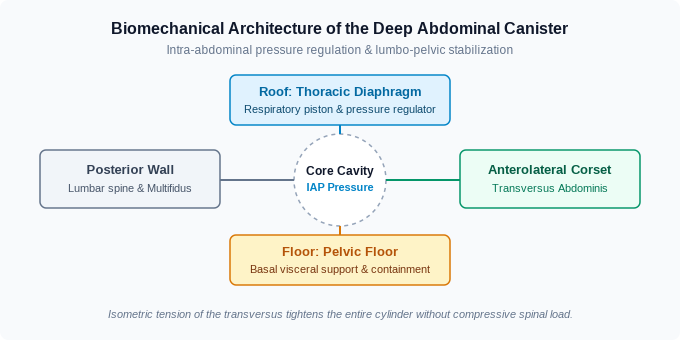
When this muscular cylinder loses coordination, the lower belly inevitably sags forward under visceral weight. This pursuit of balance and functional integrity mirrors ancient physical culture, explored in our chronicle on olive oil and ancient Greek athletic preparation.
3. The False Ribcage Inspiration: Why “Sucking in Your Stomach” Fails
3.1 The physics of the vacuum: Diaphragmatic suction and apnea
Novices routinely make an elementary error when attempting Zane’s vacuum: they simply tense their abs or pull their navel inward while holding their breath.
This voluntary belly-sucking shares nothing with an authentic vacuum. It recruits superficial fibers and drives intra-abdominal pressure upward, leaving the athlete breathless within seconds.
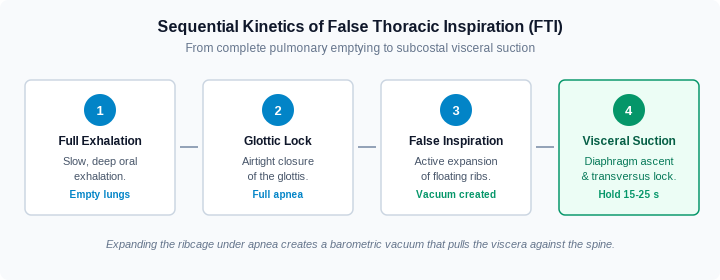
The secret relies on false thoracic inspiration (FTI).
This mechanism obeys basic fluid dynamics. When you fully exhale every cubic centimeter of air, your diaphragm rises into its highest resting dome under the ribs. By closing the glottis airtight and simulating a massive inhalation by expanding the ribcage without letting air enter, you create a profound negative barometric pressure within the thoracic cavity.
This negative pressure acts as a powerful piston. Lacking incoming air through the trachea, the thoracic cage pulls the anatomical floor dividing it from the abdomen: the diaphragm is sucked dramatically upward, carrying the digestive organs with it and flattening them against the lumbar spine.
The cavernous hollow under Frank Zane’s ribs was not produced by abdominal straining. It was the visual manifestation of an internal barometric vacuum.
3.2 Hypopressive training vs hyperpressive crunches: Dr. Bernadette de Gasquet’s clinical warnings
This understanding aligns directly with the medical breakthroughs of Dr. Bernadette de Gasquet, author of Abdominaux : arrêtez le massacre !.
Pioneering the APOR method, de Gasquet warned athletic communities against traditional spinal flexion. According to the biomechanical method of the Institut de Gasquet, repetitive sit-ups and heavy leg raises are hyperpressive exercises.
Each standard crunch compresses the abdominal cavity, thrusting the viscera downward and outward against the linea alba and pelvic floor. Over years, this fosters diastasis recti, pelvic instability, and a bulging lower belly at rest—even in athletes with single-digit body fat.
False thoracic inspiration inverts this damage. By remaining strictly hypopressive, it drops internal pressure, decompresses the pelvic floor, and conditions the transversus to fire in full anatomical retraction.
4. Demystification: What the Stomach Vacuum Can and Cannot Do
4.1 The stubborn myth of spot fat reduction
Social media routinely circulates a comforting fantasy: that daily stomach vacuums melt lower belly fat. This claim contradicts fundamental human lipolysis.
Triglyceride oxidation in adipose tissue is governed by systemic hormonal cascades and sustained caloric deficit. No isometric hold can signal adjacent adipocytes to release free fatty acids. If you carry several centimeters of subcutaneous body fat over your abdomen, the vacuum will not burn it off.
Why, then, do athletes consistently lose two inches off their waistline within weeks?
The reduction is biomechanical, not advective. In untrained individuals, the transversus is chronically deconditioned, allowing the abdominal contents to spill forward.
By retraining the muscle to maintain higher baseline resting tone, the structural diameter of the waist shrinks by 1 to 2 inches (2 to 5 cm). The waistline tightens without losing a single gram of adipose tissue.
4.2 Heavy weighted side bends and the epidemic of modern “bubble guts”
Another critical error in modern gym culture involves oblique training. For years, lifters performed heavy dumbbell side bends hoping to whittle their waists.
The biological result proved disastrous. The external obliques are large pennate muscles capable of substantial hypertrophy. Subjecting them to heavy eccentric load widens the torso laterally, converting an aesthetic V-Taper into a thick, rectangular block.
This trend escalated on international stages starting in the 1990s. As documented in medical literature on abdominal wall distension, crowds witnessed shredded, 260-pound competitors with paper-thin skin who could no longer control their midsections onstage.
This phenomenon, termed bubble gut or Palumboism, combines massive caloric throughput, visceral organomegaly, and complete loss of transversus neuromuscular control. In contrast, the Golden Era prized poise, classical lines, and internal discipline. This philosophical standard echoes the values championed at the 1901 Great Competition judged by Arthur Conan Doyle.
| Morphological & Technical Metric | Golden Era Standard (Frank Zane) | Modern Mass Era (1990s–2020s) |
|---|---|---|
| Primary Geometric Goal | Razor-sharp V-Taper, classical symmetry, narrow waist | Sheer mass, maximum muscular thickness and density |
| Stage Waist Circumference | 29 inches (73.6 cm) at 185 lbs | 34 to 38 inches (86–96 cm) at 250–290 lbs |
| Dominant Abdominal Recruitment | Deep transversus, serratus, hypopressive vacuum holds | Thick rectus abdominis, heavy obliques, hyperpressive bracing |
| Onstage Resting Posture | Continuously controlled, vacuum-ready presentation | Frequent abdominal distension and resting protrusion |
| Signature Exercises | False thoracic inspiration, pullovers, controlled leg raises | Heavy weighted machine crunches, loaded side bends |
This contrast underscores an eternal truth of physical culture: aesthetic supremacy is not defined by the mass you pack on, but by the structural proportions you protect.
5. Frank Zane’s Practical Protocol: A 4-Stage Training Progression
5.1 Motor progression: From all-fours to Zane’s overhead signature
Mastering motor control requires patience. Attempting Zane’s overhead vacuum in front of a mirror on day one almost guarantees technical failure. The nervous system requires clear proprioceptive feedback before executing a vacuum vertically.
Follow this progressive 4-stage hierarchy:
-
Stage 1: The Quadruped Position (All-Fours)
Position yourself on hands and knees with hands below shoulders and knees under hips. Keep the spine neutral. In this posture, gravity pulls the visceral mass naturally toward the floor. Slowly exhale through your mouth until your lungs are empty. Close your throat and flare your ribs: feel your organs elevate vertically toward your spine. Gravity acts as an educational ally to register transversus contraction. -
Stage 2: The Supine Position (Lying on Your Back)
Lie flat on an exercise mat with knees bent at 90 degrees and feet flat on the floor. Maintain neutral lumbar contact. Exhale fully, seal the glottis, and expand your ribcage. The tactile feedback of the floor provides an immediate reference: visualize drawing your navel down toward the floorboards. -
Stage 3: The Incline Standing Position (Hands on Thighs)
Stand with knees soft, hinging forward at 45 degrees with your palms bracing above your knees, arms extended. This position unloads the lumbar spine while offering ample freedom for costal flare. Initiate the false inspiration while supporting your torso through your arms. -
Stage 4: Frank Zane’s Signature Pose (Upright Overhead)
The pinnacle of stage mastery. Stand erect, feet shoulder-width apart. Raise both arms overhead, either clasping your hands behind your neck or locking into a classical front double biceps. Elevating the humerus stretches the latissimus dorsi and elevates the ribcage. Initiate the vacuum: the midsection collapses beneath a sculpted costal arch.
5.2 Periodization, timing, and the cross-bench dumbbell pullover secret
Integrating the vacuum into your weekly routine hinges on biological timing and quality recovery.
The ideal window is immediately upon waking, on an empty stomach, before drinking liquids or eating solids. An unburdened digestive tract enables uninhibited diaphragmatic excursion.
Dedicate ten minutes each morning:
- Working volume: 3 to 4 isometric sets.
- Duration under apnea: Begin with 15 to 20 seconds per repetition, progressing to 25 or 30 seconds of sustained vacuum.
- Rest intervals: Allow 45 to 60 seconds between efforts. Never rush: take two calm, diaphragmatic nasal breaths before beginning your next hold.
To amplify the visual impact of this deep core work, Frank Zane systematically paired the vacuum with his favorite Golden Era exercise: the cross-bench dumbbell pullover.
Lying perpendicular across a flat bench with only his upper shoulders supported and his hips slightly dropped, Zane lowered a dumbbell far behind his head on a deep inhalation. This loaded stretch expanded the costal cartilages, mobile rib joints, and recruited the serratus anterior (serratus anterior). These saw-toothed muscle bands running along the ribs, framed by a vacuumed waistline, created the unforgettable silhouette captured in Golden Era archives.
During core coaching sessions, I frequently observe athletes clenching their jaws and hiking their shoulders during vacuum holds. This parasitic tension is useless. Keep facial muscles relaxed, release your traps, and channel the suction entirely into the abdominal canister.
6. Frequently Asked Questions (FAQ)
Are there any medical contraindications to the stomach vacuum?
Yes. Although performed without external loads, glottic closure combined with post-expiratory apnea generates significant intrathoracic and cardiovascular pressure shifts. The stomach vacuum is contraindicated for individuals with uncontrolled hypertension, history of stroke or cardiac pathology, glaucoma, or during pregnancy. Anyone suffering from inguinal, umbilical, or hiatal hernias with severe reflux should also abstain and consult a physician.
How long does it take to see measurable reductions in waist circumference?
Noticeable improvements in silhouette and resting posture typically emerge within 3 to 6 weeks of dedicated daily morning practice on an empty stomach. This timeline matches the neuromuscular adaptation of the transversus abdominis, which develops a firmer resting baseline tone. A reduction of 1 to 2 inches (2 to 5 cm) at the navel without body weight loss is widely reported.
Should you stop doing crunches to achieve a tighter waistline?
To reduce waist diameter, endless repetitions of spinal flexion exercises like crunches should be replaced with deep core stabilization. Emphasize anti-extension holds (neutral-spine planks), anti-rotation drills (Pallof press), and hypopressive vacuum holds. If you train the rectus abdominis for superficial six-pack definition, use slow, controlled reverse pelvic curls without pushing the abdominal wall outward.
Can you breathe normally while holding a stomach vacuum?
During the learning phase, the exercise must be executed in complete post-expiratory apnea to maintain negative subcostal suction. Highly experienced athletes, like Frank Zane during his stage posing routines, learn to maintain isometric transversus contraction while taking shallow apical breaths at the very top of the lungs. This advanced mastery requires months of dedicated diaphragm control.