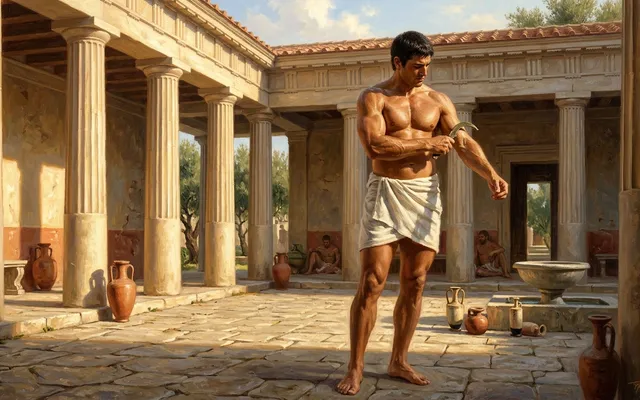
Apollo’s belt, known across athletic culture as the iliac furrow or Adonis belt, remains one of the most sought-after physical hallmarks in fitness. Yet this sharp V-shaped groove diving from the pelvic iliac crest toward the pubis is not a contractile muscle developed through endless sit-ups. It is the visible subcutaneous contour of the inguinal ligament and the external oblique aponeurosis, revealed only by low body fat and the dynamic balance of the pelvis.
To immortalize this iconic line on his David between 1501 and 1504, Michelangelo defied social taboos by performing clandestine human dissections in the crypt of the Santo Spirito basilica in Florence. By reviving the asymmetrical posture of antique contrapposto, the Renaissance master engineered an architectural tension that continues to outshine modern physique standards.
Key Takeaways:
- Not a contractile muscle: Apollo’s belt is the inguinal ligament (Fallopian arch), a dense fibrous band connecting the anterior superior iliac spine (ASIS) to the pubic tubercle.
- The contrapposto secret: David reveals this furrow through an asymmetrical pelvic shift (right weight-bearing leg, gluteus locked, opposite flank stretched), never through a static frontal contraction.
- The viral trap to avoid: Heavy dumbbell side bends cause lateral muscle hypertrophy, thickening the waistline and ruining the classic V-taper.
- The physiological threshold: The furrow only appears below a strict body fat threshold (Schoenfeld et al.), supported by deep transverse abdominis bracing.
1. Inside the Crypt of Santo Spirito: The Scalpel Reveals What Modern Fitness Ignores
1.1 Winter 1492: By Candlelight, Discovering a Fibrous Boundary
You descend the narrow, worn stone staircase beneath the foundations of the Santo Spirito basilica on the south bank of the Arno River. The damp air smells sharply of aromatic vinegar and wax.
At seventeen, following the death of Lorenzo de’ Medici, the young Michelangelo found refuge with Prior Niccolò di Lapo Bichiellini. To honor his protector, the sculptor carved a wooden crucifix of uncanny anatomical precision. In return, the prior granted him nocturnal access to a secluded chamber adjoining the monastery hospital, where unclaimed corpses rested before burial.
The flicker of your tallow candle casts dancing shadows across the rough wooden dissecting table. In your numbed December fingers, you balance the iron scalpel. Five centuries later, social media algorithms would baptize this lower abdominal fold “Apollo’s belt,” promising overnight results in six minutes a day and marketing it as a mysterious muscle. But under the flame, human anatomy tells an entirely different story.
You cut through the epidermis with measured care. Folding back the superficial adipose layer reveals the muscular planes beneath. Deep to the external and internal obliques lies the pearlescent sheet of the fascia transversalis.
The physical reality is inescapable: no autonomous muscle belly exists here. There is no isolated bundle that conscious effort can contract in isolation. This coveted line does not arise from localized muscle growth; it is an unyielding skeletal border.
1.2 The Fallopian Arch and the Oblique Aponeurosis: The True Anatomy
As you clear away the fascia, the candlelight catches a pearlescent band of remarkable rigidity. Descriptive anatomy would later name this structure the Fallopian arch, or inguinal ligament.
Measuring twelve to fourteen centimeters in length, this dense fibrous cord originates on a bony projection easily felt on your own hips: the anterior superior iliac spine (ASIS). From this pelvic anchor, it travels downward and inward to attach firmly to the pubic tubercle.
This ligament is not an isolated cord. It is the thickened, recurved inferior border of the broad terminal aponeurosis of the abdominal external oblique muscle.
Observe the direction of its fleshy fibers:
- External oblique fibers run downward and medially from the lower ribs, like hands sliding into coat pockets.
- As they approach the pelvic brim, these muscle fibers transition into a dense, inextensible white tendon sheet (aponeurosis).
- At its lower boundary, this sheet curls backward upon itself, forming an osteofibrous gutter through which the femoral vessels and nerve enter the thigh.
The visual furrow arises from this natural architectural drop. Above, the muscular belly of the external oblique forms a subtle contour. Below, the pelvic bone falls away toward the leg. In between, the inguinal ligament anchors the overlying skin firmly down to the pubic bone.
The post-mortem lesson is unambiguous: trying to pump this groove with crunches is biomechanical nonsense. To carve this line, one must tighten the aponeurotic canvas and strip away overlying adipose tissue—without adding bulk to the flanks.
2. The Trial of Carrara Marble: Why Symmetrical Contractions Fail
2.1 The Abandoned 17-Foot Colossus: Breaking Frontal Stagnation
Nine years after those nights in Santo Spirito, in August 1501, you stand in the dust-choked yard of the Opera del Duomo in Florence. Before you looms a colossal 17-foot block of white Carrara marble. The Florentines call it Il Gigante (The Giant).
The stone carries an infamous past. Forty years earlier, sculptor Agostino di Duccio gouged it so clumsily between what was meant to be the legs that city masters declared the monolith ruined. It is tall, but abnormally flat and shallow in depth.
If you attempt to carve a biblical hero standing square on both feet with flexed, symmetrical abs, the shallow stone will lack depth. The figure will appear stiff, boxy, and lifeless.
You grasp what gym-goers staring into mirrors fail to recognize: the human physique never reveals its true structural power in rigid symmetry. Symmetrical alignment flattens contour. To unleash dynamic power without thickening the torso, you must revive the ancient principle mastered by the Greek sculptor Polykleitos in the 5th century BC: contrapposto.
2.2 Contrapposto Mechanics: Pelvic Tilt, Glute Lock, and Oblique Stretch
In your Florentine studio, your chisel strikes stone. You carve David with his full bodyweight anchored onto his right leg.
This single mechanical decision completely reshapes the pelvic architecture:
- The weight-bearing leg: The right foot grips the ground. The knee locks in full extension. To stabilize the femur and prevent trunk collapse, the right gluteus maximus and medius contract with maximum force.
- Pelvic shift: Driven by the rigid right leg, the right hemipelvis tilts upward by six to eight degrees. The right ASIS rises sharply toward the rib cage.
- Abdominal wall reaction: This elevation approximates the origin and insertion of the right external oblique. The muscle bunches into a compact, firm contour, while its lower aponeurosis hollows deeply under femoral tension.
- The relaxed contralateral leg: The left leg, bent and trailing behind, carries zero axial load. The left flank stretches vertically, allowing the shoulders to counter the pelvic angle with an opposite slant.
This asymmetrical tension is not merely artistic styling; it reflects physiological accuracy so acute that modern cardiologists analyzed it with awe. In the Journal of the American College of Cardiology, Dr. Daniel Gelfman identified the “David Sign”: the precise distension of the right internal jugular vein carved by Michelangelo, documenting an elevated adrenergic state more than a century before William Harvey published the principles of blood circulation.
Dr. Stuart McGill’s ultrasound investigations into abdominal wall morphology validate this exact mechanism: during asymmetrical trunk loading, aponeurotic sheets undergo opposite multi-planar shifts. The furrow is not born of concentric muscle shortening, but from the dynamic torque of a tilted pelvis under cross-tension.
2.3 Functional Diagram: Neuromuscular Architecture of Contrapposto
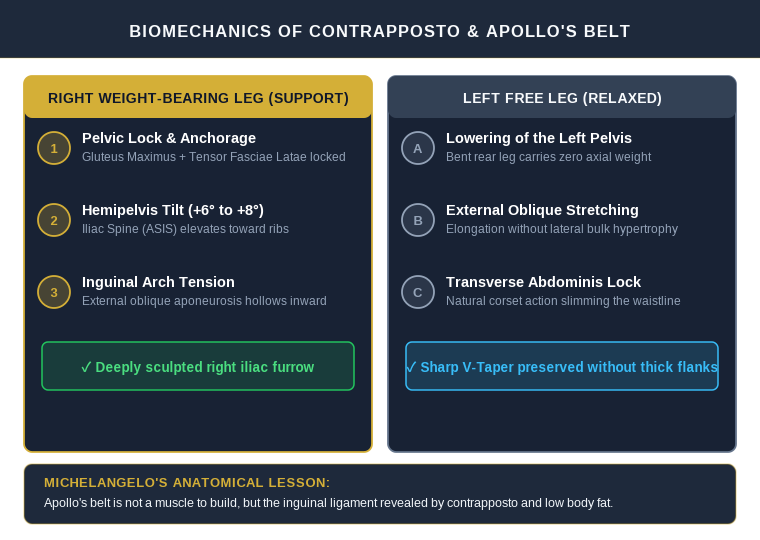 Figure 2.1: Neuromuscular architecture of contrapposto and emergence of Apollo’s belt (click diagram to enlarge).
3. The Modern Conflict: Dismantling Viral Mistakes That Thicken Your Waist
3.1 The Dumbbell Side Bend Trap: When Bulk Destroys the V-Taper
Observe what happens across modern gyms and fitness feeds. How many trainees grab a heavy dumbbell in one hand and grind out side bends? They believe they are carving the iliac V-line. They think they are chiseling Apollo’s belt.
The biomechanics deliver the exact opposite outcome.
When you perform lateral trunk flexions under heavy axial loading, you stimulate direct muscular hypertrophy in the lateral external obliques, internal obliques, and quadratus lumborum. As documented by Dr. Stuart McGill in his spine mechanics research (McGill et al.), these tissues adapt to mechanical tension by expanding their cross-sectional area.
The aesthetic consequence is devastating:
- Torso width expands laterally and from the side profile.
- The iliac crests are capped by thick, bulky muscular bulges.
- The physique loses its classic conical sweep and Golden Ratio symmetry.
Instead of defining the iliac furrow, you fill in the natural inward taper above the hip bone. While genetic frame dictates bone width, muscular flank thickening completely ruins proportions. To maintain a sharp shoulder-to-waist taper, as codified in our study on Steve Reeves’s classical proportions, your lateral abdominal wall must remain dense, flat, and tight—never hypertrophied into lateral bulges.
3.2 The Spot Reduction Myth and Critical Body Fat Thresholds
The second widespread illusion is targeted fat loss. Millions of views gather on routines promising to burn lower abdominal fat through flutter kicks and leg lifts.
Adipose tissue physiology does not operate on localized spot reduction. The fat cells overlying the inguinal ligament and iliac crests possess a notoriously high density of alpha-2 adrenergic receptors, which actively inhibit lipolysis compared to beta-2 receptors.
In elite contest preparation protocols analyzed by Dr. Brad Schoenfeld and colleagues in Sports, this lower abdominal region is consistently among the final fat depots mobilized by the body. Reaching a true body fat level below 9-10% for men (16-18% for women) remains the non-negotiable prerequisite to expose the aponeurotic ridge beneath.
Here are the measurable physiological benchmarks for inguinal visibility:
| Athletic Profile | Minimum Body Fat Threshold | Apollo’s Belt Visibility | Visual Furrow Appearance |
|---|---|---|---|
| Men – Stage Ready | 7% to 9% | Deep and razor-sharp at rest | Continuous groove from ASIS to pubis, visible aponeurosis |
| Men – Athletic & Lean | 10% to 12% | Clear in motion or contrapposto pose | Subtle inguinal depression, prominent under tension |
| Men – Standard Fitness | 14% to 16% | Concealed | Covered by lower subcutaneous adipose layer |
| Women – Athletic & Lean | 16% to 18% | Elegantly outlined | Soft, graceful curve without extreme striation |
| Women – Standard Fitness | 20% to 24% | Naturally cushioned | Normal physiological pelvic protection |
Until you cross this body fat threshold through a calculated caloric deficit and adequate protein intake, no abdominal exercise will make this groove appear. The kitchen reveals what Michelangelo’s scalpel mapped.
3.3 Stage Experience: 18 Years of Competitive Bodybuilding Posing
Through 25 years of dedicated iron training and 18 years preparing for natural bodybuilding stages, I have lived this battle to reveal the lower abdominal lines.
Under blinding 1,000-watt stage lights, judging panels do not reward distended, bulky midsections. They search for waist tightness and crisp anatomical insertions.
I have witnessed dozens of gifted athletes throw away months of dieting by abusing heavy oblique twists or cable side bends. Their waists grew an inch thicker. Their silhouettes turned rectangular.
On stage, when hitting a three-quarter angle or the classic abdominal-and-thigh pose, you never stand squared forward. You shift your weight onto one leg.
You subtly tilt the pelvis into posterior rotation. You lock the stance glute while drawing the abdominal wall inward with the transverse abdominis. It is the exact posture Michelangelo carved in Carrara marble.
4. The Workshop Routine: Forging David’s Line Without Widening Your Waist
4.1 Movement 1: The Hanging Pelvic Curl with Active Posterior Tilt
Leave the quiet of crypts and marble dust behind and step onto the gym floor. The pull-up bar becomes your sculpting anvil.
Most trainees executing hanging leg raises make a fundamental error: they pull solely with their hip flexors (psoas and rectus femoris). Their legs swing upward, but their pelvis remains rigid. The lower abdominal wall achieves zero genuine pelvic flexion.
To properly target the lower external oblique aponeurosis and rectus abdominis sheath:
- Hang from a pull-up bar using an overhand shoulder-width grip. Engage your lats to stabilize your scapulae.
- Bend your knees slightly to roughly 90 degrees to disengage hamstring tension.
- Do not focus on driving knees to chest. Focus on curling your pubic bone upward toward your sternum.
- Your pelvis must rotate backward into a complete posterior tilt at the peak. Hold a full one-second isometric lock.
- Lower under a strict three-second eccentric tempo without letting your legs swing backward past vertical.
4.2 Movement 2: Long-Lever Posterior-Tilt Plank (Schoenfeld & Contreras)
To forge a firm, dense abdominal wall without adding lateral muscle mass to the obliques, standard static planks are insufficient.
In biomechanical research published by Brad Schoenfeld and Bret Contreras in Sports Biomechanics, researchers compared standard prone planks against a modified variation combining an elongated lever arm with active posterior pelvic tilt. Electromyographic data showed dramatic increases in rectus abdominis and external oblique activation—with zero compressive spinal overload.
Here is how to set up the movement:
- Place your forearms on the floor well forward of your shoulders (roughly 4 to 6 inches further out than a standard plank).
- Step your feet back to lengthen the lever arm as far as possible.
- Squeeze your glutes with maximum force to drive your pelvis into posterior tilt, as if tucking your tailbone under.
- Draw your navel hard toward your spine.
Hold this position for intense, focused intervals of 20 to 30 seconds. You are not pursuing passive endurance, but maximum voluntary myofibrillar contraction.
4.3 Movement 3: Asymmetrical Contrapposto Vacuum (Transverse Abdominis)
The third mechanical pillar relies on the transverse abdominis, as detailed in our comprehensive guide on Frank Zane’s stomach vacuum technique.
The transverse acts as an internal anatomical corset. Its horizontal fibers encircle the visceral cavity. Contracting it under respiratory depression pulls the abdominal wall inward toward the spine, throwing the iliac crest and inguinal ligament into sharp relief.
Execution guidelines adapted from David:
- Stand tall with feet hip-width apart.
- Shift 85% of your bodyweight onto your right leg, locking the right knee and clenching the right glute.
- Soften the left knee, placing only the ball of the left foot lightly on the floor, hip dropped forward.
- Exhale all air completely from your lungs through your mouth in a steady stream.
- Without inhaling, vacuum your stomach up and back beneath your rib cage (thoracic false inspiration).
- Hold this asymmetrical lock for 15 to 20 seconds, feeling the deep tension along the right inguinal arch.
4.4 Training Protocol & Programming Guidelines
Incorporate these three movements twice weekly at the conclusion of your training sessions without interfering with heavy compound lifts:
| Exercise | Anatomical Target | Sets & Reps | Tempo | Focus & Execution Cue |
|---|---|---|---|---|
| Hanging Pelvic Curl | Oblique aponeurosis & lower rectus | 3–4 sets of 10–12 reps | 3-1-1-1 (3s down, 1s peak hold) | Zero swing, curl pubis to sternum |
| Long-Lever Posterior Plank | Deep fascial tension & glute drive | 3–4 sets of 25–30s | Maximum isometric contraction | Glutes fully locked, elbows extended |
| Contrapposto Stomach Vacuum | Transverse corset & inguinal contour | 3 sets per side of 15–20s | Full expiratory apnea | Pronounced weight shift onto active leg |
5. Epilogue Under the Florentine Sky: The Enduring Classical Ideal
On September 8, 1504, a dense crowd gathered on the Piazza della Signoria in Florence. After days of delicate transport on greased wooden rollers from the Duomo workshop, David was finally unveiled before the doors of Palazzo Vecchio.
The rising Tuscan sun struck the Carrara marble. What the citizens of Florence beheld was not a swollen brute loaded with useless muscle bulk. They contemplated a young man in silent vigilance, where every fiber answered an exact mechanical purpose.
The iliac furrow running from his right hip to his pubis is not the byproduct of casual gym routines. It stands as a timeless testament to clandestine anatomical dissection, antique Greek geometry, and the architectural tension of contrapposto.
On the gym floor today, physiology still makes no compromises. Stop chasing shortcuts in fleeting social media trends. Strip away excess fat, master pelvic mechanics, and allow your body’s authentic architecture to reveal its full, classic power.
To explore more stories where modern biomechanics illuminates the golden history of physical culture, take time to explore the founding chronicles of Golden Era.
6. Frequently Asked Questions
Can anyone develop an Apollo’s belt?
Yes. Anatomically, every human possesses an inguinal ligament connecting the ASIS to the pubic tubercle. Visibility is dictated by subcutaneous body fat (Schoenfeld et al.) and pelvic bone geometry. A broader pelvis creates a sharper natural groove, while a narrower structure requires stronger transverse abdominis engagement to draw the line forward.
Why do heavy dumbbell side bends thicken the waistline?
Dumbbell side bends place high tensile loads on the external obliques, internal obliques, and quadratus lumborum. In response, these muscles increase their cross-sectional area laterally. This muscle growth thickens the flanks and obliterates the aesthetic V-taper of classical proportions.
What is the most effective exercise to reveal the iliac furrow?
The primary movement is the hanging leg-pelvic raise with an active posterior pelvic tilt at peak contraction. By curling the pubis toward the sternum without momentum, you activate the lower external oblique aponeurosis. Paired with long-lever planks and vacuum posing, this creates a tight, tapered waistline.
How long does it take to reveal the iliac V-line?
The timeline depends on starting body fat. For a trainee with moderate leanness, it typically requires 8 to 14 weeks of a structured caloric deficit to oxidize the stubborn lower abdominal fat layer shielding the Fallopian arch (Schoenfeld et al.).