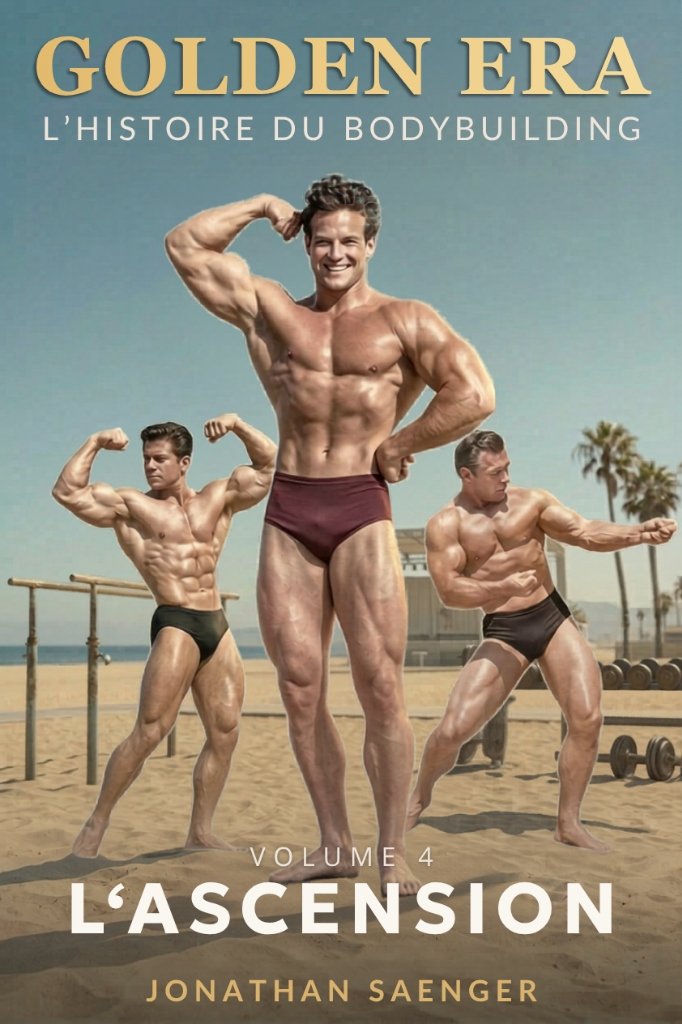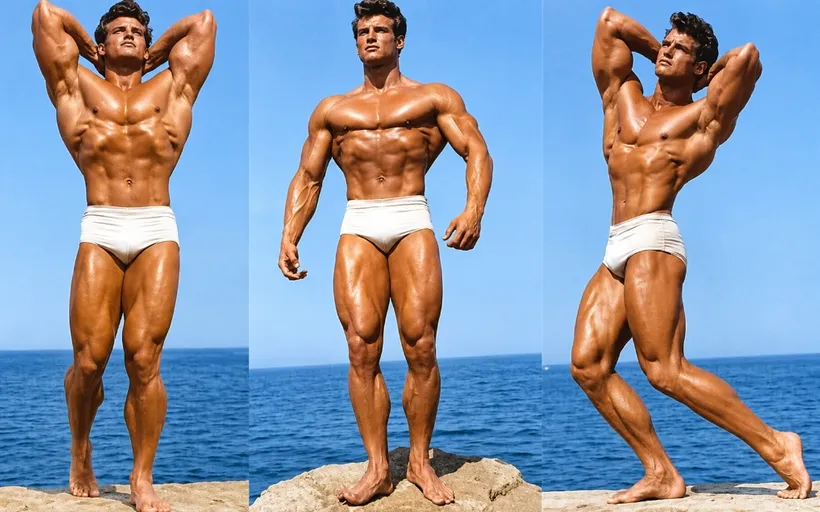
The Steve Reeves rule defines the mathematical calculation of ideal proportions in natural bodybuilding. Inspired by classical Greek sculpture and the Golden Ratio (1.618), this method rests on perfect symmetry in which neck, arm, and calf circumferences measure the exact same value, paired with an ultra-tight waist.
In Brief:
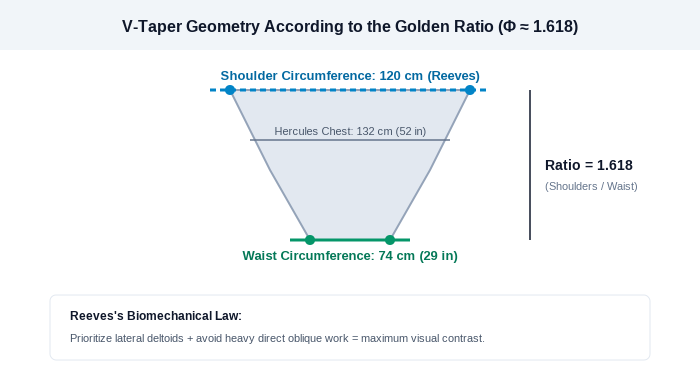
- The Golden Rule of the V-Taper: a shoulder circumference to waist ratio equal to 1.618 (120 cm / 74 cm for Reeves).
- The Symmetrical Triad: exact equality between the neck, arms, and calves (47 cm / 18.5 in measured cold at his 1950 Mr. Universe victory).
- Osteological Calculation: muscular potential dictated by joint diameters (arm = 2.52 × wrist, calf = 1.92 × ankle).
- The Muscle Beach Method: a Full-Body workout 3 times per week using double progression with 48 hours of systemic supercompensation.
1. The Gold Standard of Hercules: When Steve Reeves Reincarnated the Greek Canon
1.1 From the 1950 Mr. Universe Triumph to the Silver Screen in 1958
On June 24, 1950, on the stage of London’s Scala Theatre, the NABBA judging panel crowned a 24-year-old American whose silhouette stunned the audience. Facing the raw density of Britain’s Reg Park, Steve Reeves imposed a masterful stage presence, as recorded in the archives of Mister Universe. He did not seek to overwhelm his rivals with shapeless mass.
At 215 lbs (97.5 kg) and 6 ft 1 in (1.85 m), he displayed a structural balance the public had not witnessed since the master sculptors of Attica. Eight years later, Italian director Pietro Francisci was searching for a credible colossus to portray the mythological demigod in Hercules (1958). When Reeves appeared on screen, the visual shock crossed continents.
Audiences discovered an athlete whose frame commanded awe without ever betraying grace of movement. His proportions embodied the Greek ideal of classical bodybuilding. For the first time, physical culture stepped out of basement gyms to triumph on the silver screen. Biographical records in the official Steve Reeves archives show how this coronation redefined the bodybuilder—from carnival curiosity to living incarnation of the classical hero.
1.2 The Lineage of Polykleitos and Ancient Sculpture
This visual perfection was no accident of genetics left to chance. From his earliest training years in Oakland under mentor Ed Yarick, Reeves rejected haphazard muscular development. He studied ancient proportions to build harmonious hypertrophy inspired by the Greek sculptor Polykleitos of Argos.
Around 440 BC, Polykleitos formalized in his treatise—embodied by the statue of the Doryphoros—the principle of commensurability of forms. According to this vision, the beauty of a human body lies in the exact mathematical ratio between each anatomical segment: finger to palm, palm to forearm, and each limb to the entire torso.
This aesthetic lineage revolves around three immutable principles:
- Overall harmony over raw mass: every muscle group is shaped in proportion to the underlying bone structure.
- Respect for the classical line: broad shoulders catch the light while the waist remains understated.
- Kinetic coherence: an athletic physique must be able to run, swim, and fight without being hindered by its own bulk.
Where contemporary bodybuilding often prizes extreme hypertrophy at the expense of joint health, Reeves defended a pure athletic line. Visceral distension caused by modern chemical cocktails destroys this symmetry. Conversely, the classical approach sculpts a functional, mobile, and lasting physique—continuing the historical foundations we analyzed in the first 1901 bodybuilding contest judged by Arthur Conan Doyle.
2. Body Geometry: The Golden Ratio (1.618) and the Absolute V-Taper
2.1 The Divine Proportion Applied to the Shoulder-to-Waist Ratio
The fascination exerted by Steve Reeves’s silhouette rests on a precise geometric relationship. In nature, architecture, and fine art, the Greek letter Φ denotes the divine proportion, or Golden Ratio, approximately equal to 1.618. This ratio governs plant spirals, the nautilus shell, and the facades of the Parthenon.
Applied to the human body, this mathematical law dictates the balance between upper-body breadth and waist narrowness:
V-Taper Ratio = Shoulder Circumference ÷ Waist Circumference ≈ 1.618
Measured cold, Steve Reeves displayed a bi-deltoid circumference of 119.7 cm and a tight 74 cm waist. His ratio reached 1.6175—virtually identical to Φ.
This visual differential sculpts the famed V-Taper, making the upper torso appear to float above a compact pelvis.
Many lifters make the mistake of thickening their midsection with heavy weighted side bends or oblique work, which widens the trunk and ruins the line. To preserve a narrow waist, strengthening the deep abdominal wall is decisive, just like the Frank Zane stomach vacuum protocol designed to tighten the transverse abdominis.
2.2 The Lateral Deltoid Secret: Widening the Frame Naturally
To accentuate this contrast without chemistry, Reeves prioritized the lateral head of the deltoid, whose sweep immediately widens the front silhouette.
On the gym floor, Steve Reeves relied on three strict shoulder exercises:
- Wide-grip dumbbell upright rows: rather than a barbell that binds the wrists and overloads the upper traps, Reeves held dumbbells slightly apart to direct tension onto the lateral deltoid.
- Incline side laterals: lying sideways on a 45-degree incline bench eliminates torso momentum and places the muscle under tension from the very start of the lift.
- Seated behind-the-neck press with moderate grip: performed seated to lock the pelvis and prevent lumbar hyperextension.
Old-school physical culture never chased ego weight for its own sake. To explore the founding chronicles of Golden Era, remember that every exercise served a precise aesthetic blueprint first.
3. The Classical Symmetrical Triad: Neck, Arms, and Calves at 47 cm
3.1 The Rule of Three-Dimensional Equality
Beyond frontal width, the harmony of a physique is judged from every angle. Here lies the most famous principle of classical physical culture: the geometric triad of equality.
Three measurements must match to the millimeter:
Neck Circumference = Flexed Arm Circumference = Standing Calf Circumference
At his competitive peak during his world title victory, Reeves measured 46.5 to 47 cm (18.25 to 18.5 in) on each of these three segments. This agreement creates an impression of unshakeable balance, allowing the eye to flow smoothly from head to toe.
Modern gym culture has largely abandoned this rule. Countless lifters boast pumped 45 cm arms while trailing 37 cm calves and a 38 cm neck.
That imbalance creates a top-heavy “ice-cream cone” silhouette. In the classical arena, such disproportion immediately penalized an athlete in the judges’ eyes.
3.2 The Reeves Method for Bringing Up the Neck and Calves
How did Reeves correct lagging points? He applied strict corrective protocols the moment a discrepancy appeared in his training log.
For the neck, he refused to rely solely on compound lifts like deadlifts. He used a leather neck harness loaded with plates or manual resistance with a thick towel:
- Controlled cervical flexions and extensions: 3 sets of 15 to 20 slow, smooth repetitions to build the sternocleidomastoid and splenius muscles.
- Biomechanical caution: zero jerky or ballistic loading, as the cervical spine tolerates sudden acceleration poorly.
For the calves—notoriously stubborn in tall athletes—Reeves trained barefoot or in thin socks to maximize ankle range of motion:
- Single-leg dumbbell calf raises: standing with the ball of the foot on a 10 cm wooden block, letting the heel sink into a full stretch below parallel.
- Three-count stepped tempo: a 3-second controlled descent, a full 2-second pause at the bottom to eliminate the Achilles tendon’s elastic bounce, followed by a high contraction at the peak.
4. Steve Reeves’s Osteological Calculator: Your Natural Measurement Limits
4.1 Formulas Based on Bone Structure
In his reference book available through the official Steve Reeves publications, Building the Classic Physique: The Natural Way (1995), the champion formulated a clear thesis: bone structure dictates an individual’s natural muscular ceiling.
Reeves refused to impose a one-size-fits-all template. A fine bone frame will never harmoniously carry the bulk of a thick-boned endomorph. To establish each drug-free athlete’s target potential, he calculated a series of ratios linking bone joints to muscular girths:
- Arm circumference: 2.52 × wrist circumference
- Calf circumference: 1.92 × ankle circumference
- Thigh circumference: 1.75 × knee circumference
- Chest circumference: 1.48 × hip (pelvis) circumference
- Waist circumference: 0.86 × hip (pelvis) circumference
This alliance between anatomy and osteology preserves the elegance of the line while protecting tendons from excessive loading.
4.2 Comparison Table: Calculate Your Target Measurements
Take a flexible tape measure and measure your wrist at its narrowest point, just above the styloid process of the radius and ulna.
The table below shows theoretical target measurements according to your bone frame:
| Bone Frame | Wrist Girth | Target Arm (cm) | Target Calf (cm) | Target Neck (cm) | Target Chest (cm) | Target Waist (cm) | Athletic Weight Range |
|---|---|---|---|---|---|---|---|
| Very fine frame | 16.0 cm | 40.3 cm | 40.3 cm | 40.3 cm | 118.5 cm | 70.5 cm | 68 to 73 kg (for 1.70 - 1.74 m) |
| Fine frame | 17.0 cm | 42.8 cm | 42.8 cm | 42.8 cm | 123.0 cm | 73.0 cm | 74 to 79 kg (for 1.74 - 1.78 m) |
| Medium frame | 18.0 cm | 45.4 cm | 45.4 cm | 45.4 cm | 128.5 cm | 76.0 cm | 80 to 86 kg (for 1.78 - 1.83 m) |
| Robust frame (Reeves) | 18.5 cm | 46.6 cm | 46.6 cm | 46.6 cm | 132.0 cm | 74.0 cm | 92 to 98 kg (for 1.84 - 1.86 m) |
| Large frame | 19.0 cm | 47.9 cm | 47.9 cm | 47.9 cm | 135.0 cm | 79.5 cm | 88 to 95 kg (for 1.84 - 1.88 m) |
| Heavy frame | 20.0 cm | 50.4 cm | 50.4 cm | 50.4 cm | 141.0 cm | 83.0 cm | 96 to 104 kg (for > 1.88 m) |
To ensure accurate readings, follow three golden rules:
- Measure cold: take measurements first thing in the morning on an empty stomach, before any muscle pump.
- Measure limbs contracted: flex the biceps at its peak and tense the calf standing on tiptoe.
- Measure the torso relaxed: measure the chest after a normal inhalation and the waist at the navel without sucking in the stomach.
5. The Muscle Beach Training Matrix: The True 3x/Week Full-Body Routine
5.1 Top-to-Bottom Architecture and 48-Hour Supercompensation
Under the California sun of the 1950s, the world epicenter of physical culture thrived on the sand of Muscle Beach in Santa Monica. While later generations split the body across 5 or 6 days, Reeves favored three complete full-body workouts per week: Monday, Wednesday, and Friday.
This cadence respects natural human physiology. Heavy training taxes nervous reserves deeply. For a natural athlete, 48 hours of complete rest between workouts allows protein synthesis to finish repairing muscle fibers—a balance between effort and recovery echoing the ancient practices explored in our study on gloios and olive oil rituals in Greek gymnasiums.
The architecture of the Steve Reeves workout followed a descending “Top-to-Bottom” order:
- Shoulders first: train the deltoids while nervous energy is freshest to prioritize width.
- Chest and back second: the major torso muscles handle the heaviest compound loads.
- Arms and thighs third: biceps, triceps, and quadriceps receive direct work without wasted time.
- Calves, abs, and neck last: finishing segments close the session without draining early systemic energy.
5.2 Complete Workout Protocol and Double Progression
The technical execution of Reeves’s sessions, documented on the official Steve Reeves blog, revolves around double progression.
Within a target range of 8 to 12 repetitions, keep the same weight until you can complete 12 strict reps across all 3 sets. Once achieved, increase the load by 2 to 5 kg, bringing your reps back down to 8, and climb back up to 12.
| Order | Target Muscle | Selected Exercise | Sets | Reps | Rest | Key Execution Cue |
|---|---|---|---|---|---|---|
| 1 | Shoulders | Wide-grip dumbbell upright row | 3 | 8 to 12 | 45 s | Elbows high, continuous tension on lateral deltoids |
| 2 | Chest | Incline dumbbell press | 3 | 8 to 12 | 60 s | 30° incline bench, 3-second controlled descent |
| 3 | Lats | Wide-grip lat pulldown or chin-ups | 3 | 8 to 12 | 60 s | Full scapular retraction at the bottom |
| 4 | Triceps | Lying barbell triceps extension | 3 | 8 to 12 | 45 s | Elbows fixed pointing up, strict extension |
| 5 | Biceps | Incline dumbbell curl | 3 | 8 to 12 | 45 s | Full supination at the top to recruit the biceps |
| 6 | Quadriceps | Barbell front squat | 3 | 8 to 12 | 60 s | Upright torso to spare the waist and load the quads |
| 7 | Ribcage | Cross-bench breathing pullover | 3 | 15 to 20 | 45 s | Deep inhalation at the bottom to stretch the ribcage |
| 8 | Calves | Single-leg standing calf raise | 3 | 12 to 15 | 45 s | 2-second pause in full stretch at the bottom |
| 9 | Core & Neck | Reverse crunches & weighted neck harness | 3 | 15 to 20 | 45 s | Smooth movements with zero ballistic momentum |
Pay special attention to pairing front squats with breathing pullovers. By favoring front squats over back squats, Reeves prevented excessive glute thickening and kept his side profile razor-sharp.
6. Frequently Asked Questions: Mastering Steve Reeves’s Proportions
What were Steve Reeves’s exact measurements at his peak?
At his competitive peak in 1950, Reeves stood 1.85 m (6 ft 1 in) and weighed 97.5 kg (215 lbs). His measurements included a 132 cm chest, a 74 cm waist, a 119.7 cm shoulder circumference, and a symmetrical triad of 47 cm for his neck, arms, and calves.
Can you achieve the 1.618 ratio without elite genetics?
This ratio remains a geometric ideal accessible to any disciplined practitioner. Even with an average bone frame, building the lateral deltoids widens the silhouette while respiratory control of the transverse abdominis keeps the waist flat. Everything depends on the visual contrast between the upper torso and the waist.
Why do a Full-Body workout 3 times a week instead of a 5-day Split?
A Full-Body routine stimulates muscle protein synthesis every 48 hours while sparing the central nervous system. For a natural bodybuilder without anabolics, multiplying daily workouts often leads to adrenal exhaustion and tendonitis.
How do you measure wrist and ankle circumference accurately?
Use a flexible tape measure. Measure your wrist just above the styloid process of the ulna with an open hand. Measure the ankle at the narrowest point above the malleoli while standing. Place the tape without compressing the flesh to obtain an exact bone reference.