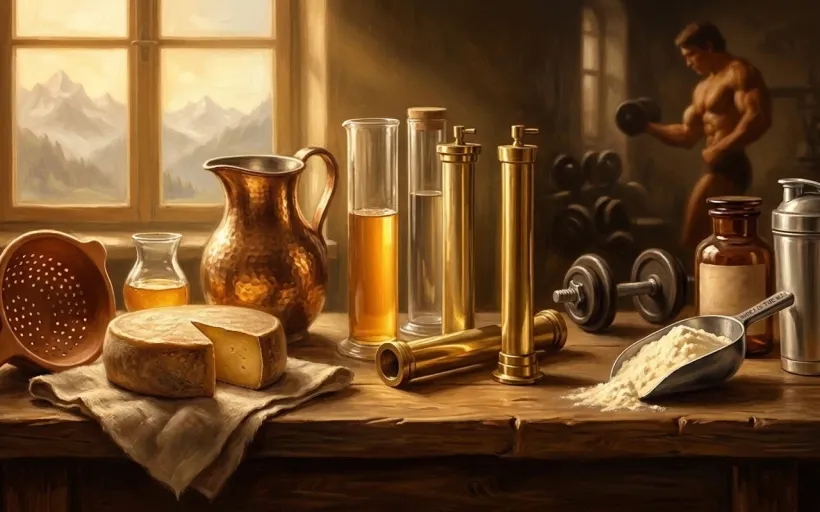
Today, it lines the shelves of gyms, kitchen cupboards, and even mainstream supermarkets. Yet for most of its history, whey protein was anything but a trendy supplement: it was a troublesome liquid byproduct that cheesemakers literally did not know what to do with.
Its journey is one of the greatest reinventions in food history. From prehistoric pottery strainers to Alpine spa resorts in Switzerland, through an overlooked ecological crisis and a Coca-Cola soda, here is how humble cheesemaking runoff became a worldwide phenomenon.
In summary: Whey protein was not invented in a fitness lab. Liquid whey has existed since the birth of cheesemaking 7,000 to 8,000 years ago, enjoying an early medical golden age from Hippocrates to Swiss Alpine cures (Molkenkur). Modern soluble, digestible whey powder was born industrially in 1970–1971 through cold membrane ultrafiltration — driven by environmental laws banning dairies from dumping whey into rivers — before conquering athletic shakers in the early 1990s (notably with Designer Whey in 1993).
1. A 7,500-Year-Old “Invention” Born from Rejection
Before becoming vanilla or chocolate powder inside a shaker bottle, whey was simply the watery runoff left behind whenever milk was turned into cheese.
Its story begins roughly 7,000 to 8,000 years ago, during the Neolithic era, alongside the very first cheeses. When milk curdles under the effect of natural acidity or enzymes such as rennet, it splits into two fractions:
- a solid fraction, the curds (rich in casein), which becomes cheese;
- a yellowish-green liquid fraction, whey, composed mostly of water, lactose, minerals, and soluble proteins.
The archaeological clue: In 2012, researchers from the University of Bristol published in Nature the chemical analysis of 34 perforated ceramic fragments excavated in the Kujawy region of Poland and dated to around 5500 BC. The verdict: they were cheese strainers, the oldest direct evidence of cheesemaking in Europe. Why did our ancestors go to the trouble of straining milk? Because most adult humans at the time were lactose intolerant. By draining away the liquid (whey, loaded with lactose), they obtained a solid, nourishing, digestible cheese.
In other words, whey was never what early herders set out to make: it was precisely what they wanted to get rid of.
2. From Hippocrates to London’s “Whey Houses”: The Forgotten Golden Age
While farmers happily fed leftover whey to pigs, physicians recognized a health tonic in it very early on.
As far back as the 5th century BC in Ancient Greece, Hippocrates, the father of medicine, prescribed liquid whey (which he called serum) as a restorative remedy for digestive and skin ailments. Centuries later, the renowned Roman physician Galen carried the torch and popularized its medicinal use across the Empire.
Yet it was between the 17th and 19th centuries that whey enjoyed its first genuine European fashionable heyday:
- London’s “whey houses”: During the 17th and 18th centuries, establishments devoted to whey opened across England. Patrons gathered there to drink a fresh glass of whey and converse, much like today’s coffee shops.
- The Swiss Alpine cure craze (Molkenkur): Starting in 1749, the small village of Gais in the Swiss canton of Appenzell became the cradle of a new kind of medical tourism. Europe’s bourgeoisie flocked to the Alps to drink still-warm goat whey at dawn — and sometimes even bathe in it. A British physician remarked wryly in 1869 that English patients found the drink far tastier when prepared by an Appenzell native… and even more effective if he wore his traditional regional costume.
At the time, no one knew anything about amino acids or muscle protein synthesis. The trend relied purely on empirical observation, and it hit a hard practical wall: fresh whey spoils within hours. Bottling it or shipping it far from Alpine pastures was impossible. With 20th-century industrialization, the fashion gradually faded away.
3. The 1970s: When Modern Whey Protein Was Truly Invented
If you are looking for the official invention date of modern powdered whey protein, look to the very beginning of the 1970s. And its birth had nothing to do with bodybuilding: it grew out of an ecological and industrial headache.
A Waste Liquid Suffocating Rivers
As large-scale industrial cheese factories expanded after World War II, one ratio became staggering: producing 1 kilogram of cheese generates roughly 9 liters of liquid whey. Millions of tons accumulated every single year.
For decades, the easiest option had been to pour it into rivers or spread it over fields. The catch: liquid whey is a potent environmental pollutant. Packed with organic matter (especially lactose), its biochemical oxygen demand is 100 to 150 times higher than domestic sewage. Dumped untreated into waterways, it triggers bacterial blooms that strip dissolved oxygen from the water and literally suffocate aquatic life.
During the 1960s and 1970s, environmental legislation tightened across North America, Europe, and Oceania: dumping whey into nature became illegal. Dairies faced an expensive dilemma: pay steep wastewater treatment fees, or invent a way to turn the liquid into a profitable product.
The Technological Breakthrough: Cold Ultrafiltration (1970–1971)
Researchers had already tried drying whey in the 1930s (notably via spray drying), but high heat denatured the proteins. The outcome was a gritty, yellow-brown powder that refused to dissolve in water and tasted appalling — fit only for livestock feed.
The breakthrough arrived in 1970–1971, when the dairy industry borrowed a technology originally created for seawater desalination: cold membrane filtration (specifically ultrafiltration).
The mechanism is gentle and purely physical: liquid whey is pushed across microscopic semi-permeable membranes. Larger molecules (proteins) are retained while water, lactose, and mineral salts pass through. Without harsh heat, the proteins remain intact, soluble, and easy to digest. In September 1970, the New Zealand Dairy Research Institute (NZDRI) produced one of the very first food-grade whey protein concentrates (WPC), swiftly followed by industrial plants in the United States and Europe.
The Coca-Cola anecdote: Before gyms ever took notice, Coca-Cola played a pioneering role in industrializing whey protein. Because whey proteins possess the rare property of remaining soluble in acidic liquids, the Atlanta giant built a pilot ultrafiltration plant in Brazil and launched Tai in 1971, an orange-flavored sparkling soft drink fortified with whey protein (followed by Sansón in Mexico). The goal was to offer affordable nutritious beverages in emerging markets.
Throughout the 1980s and 1990s, further refinements (microfiltration, diafiltration, ion exchange) pushed purity even further, yielding whey protein isolate (WPI) with over 90% protein and virtually no lactose.
4. The 1990s: How Whey Conquered Gym Shakers
For decades, bodybuilding pioneers did not drink whey. In the 1950s and 1960s, the first commercial protein powders marketed to athletes — such as Bob Hoffman’s Hi-Proteen (1952) or the blends formulated by Irvin Johnson (better known as Rheo H. Blair) — relied on soy flour, egg, or casein. Their taste and clumpy texture were so punishing that finishing a glass required serious willpower.
The shift to whey happened in the early 1990s, driven by three converging breakthroughs:
- Scientific validation: Nutrition scientists highlighted whey’s exceptional biological value, its natural abundance of essential amino acids (especially leucine, a key trigger for muscle protein synthesis), and its rapid digestion.
- Instantization: An agglomeration process finally allowed the powder to mix smoothly in seconds inside a simple shaker of cold water, without turning into gluey clumps.
- Sports marketing: In 1993, the American company NEXT Proteins launched Designer Whey, widely credited as the first flavored, instantized whey powder designed for mainstream fitness consumers. Brands such as EAS, Optimum Nutrition, and CytoSport quickly followed, bringing whey far beyond hardcore bodybuilding circles.
What had once cost cheesemakers money to destroy soon became more valuable, kilogram for kilogram, than many cheeses themselves.
5. Summary: The Timeline of Whey in 5 Key Dates
| Era | Milestone | What Changed |
|---|---|---|
| ~5500 BC | First cheese strainers (Poland) | Liquid whey emerges as the unwanted byproduct of cheesemaking. |
| 5th century BC | Prescriptions of Hippocrates | Whey is first documented as a restorative medical tonic. |
| 1749 – 19th century | Alpine cures (Molkenkur) & whey houses | Fresh liquid whey becomes a fashionable wellness drink across Europe. |
| 1970 – 1971 | Cold membrane ultrafiltration | Industrial invention of soluble, digestible whey concentrate (WPC) under environmental pressure. |
| 1993 | Launch of Designer Whey | Birth of the modern instantized whey market for everyday athletes. |
Key Takeaway
Whey protein is far from a synthetic compound cooked up in a fitness lab. Its history is one of double irony: a liquid residue that Neolithic herders drained off to digest milk, and that 20th-century dairies had to filter to stop polluting rivers, turned out to be one of the most complete protein sources in the human diet.
To explore more of the Golden Era’s training and physical culture, read our chronicles on Larry Scott, the first Mr. Olympia, Frank Zane’s legendary Stomach Vacuum, the ancient Greek gloios ritual praised by Galen, or browse all archives of The Golden Era (1965–1984).
6. Frequently Asked Questions (FAQ)
When was whey protein officially invented?
It depends on what you mean: liquid whey has existed since the birth of cheesemaking (7,000 to 8,000 years ago), but modern whey protein powder (cold-filtered, soluble, and digestible) was born industrially in 1970–1971 thanks to membrane ultrafiltration. Its mainstream sports boom began in the early 1990s (notably with Designer Whey in 1993).
Is whey protein chemical or natural?
Its raw material is completely natural: liquid whey separated from milk during cheesemaking. Turning it into powder relies primarily on physical processes (filtering through microscopic membranes, then drying). Only the optional ingredients added afterward (flavorings, sweeteners, lecithin) vary from one product to another.
Why did cheesemakers start filtering whey in the 1970s?
Because every kilogram of cheese generates about 9 liters of liquid whey, which is severely polluting to rivers. Faced with stricter environmental laws banning river disposal, the dairy industry invested in membrane filtration to transform a costly waste-treatment problem into a profitable ingredient.
What is the link between Coca-Cola and whey protein?
In the early 1970s, Coca-Cola was one of the first companies to fund whey ultrafiltration facilities. The company launched an orange-flavored sparkling beverage enriched with whey protein in Brazil in 1971 (Tai), followed by another in Mexico (Sansón), well before the rise of modern gym shakers.


